|
Art Review
The Art of Robert Tracy – An Appreciation.
by Robert Knapp, Ph.D. |
|
Robert Tracy is a self-taught romantic-realist artist. At the time he began his art career, non-objective art held a near monopoly to the claim of serious art. The art schools were among the staunchest supporters of that monopoly. The choice was to get on board or go your own way. Robert Tracy went his own way.
A casual perusal of his web site will reveal the range of his accomplishment. He has mastered oils, water colors, pencil, silver point, and acrylics. He is equally at home with painting the human figure, still life, portraits, and landscapes. His style is marked by a focused clarity and a keen sense of balance. The subjects are attractive and are intended to be contemplated and enjoyed.
Tracy’s art is not fashionable. It does not seek to shock, affront, distort, deconstruct, or dissolve. It seeks only to invite you in to share his world.
What is that world? For the most part, it is a world of peace and absorption. It is a world of people, and sometimes animals, who are intently focused on whatever they happen to be doing. A girl lovingly holds a cat. Or shoulders a miniature alligator. Or puts on makeup or an earring. Or contemplates a vista. Or reads. Or does homework. A cat stalks its prey. Or looks out the window. Or enters the house seeking attention. Though there can be drama, there is little conflict and usually no social interaction.
|
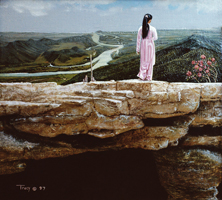
One of my favorites is called “Early Afternoon”. A young woman stands high on a natural rock bridge contemplating the sunlit vista below. The bottom two thirds of the painting is the land bridge and all the interest is in the top 1/3 of the painting. This top part is dominated by the woman, whose shoulders just clear the horizon. Who is this woman? She stands bathed in brilliant sunlight, clothed in a long pink dress that reaches her ankles. She appears young and her dress is attractive, but she has her back to you and you cannot see her face. Yet you are drawn into the landscape because she is looking at it. And you appreciate the woman because she has paused to contemplate such a setting. The serene peace acquires drama because of the placement and the contrasts. The brilliant pink dress sets off the greens and blues of the valley below and the darker tones of the rocks and shadows beneath her feet provide a contrast to both.
|

Another favorite of mine, “Approaching Storm” sits at the other end of the spectrum. The drama is intense. However, it is not the drama of color contrasts, but of menace. There is only one color – ominous blue. The white clouds in the center set off the dark clouds that surround them and the myriad of even darker birds whose restless swirling dominates the sky. Two birds, perched on a thick wire, provide a stark contrast while anchoring the scene in a world of normalcy. Yet that anchor has no base: Neither end of the wire is in sight and the wire seems suspended in space like the eye of a hurricane.
|
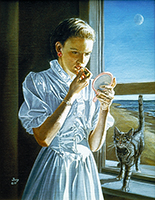
One of the most interesting compositions is “Girl Applying Lipstick”. It’s an early spring or summer evening. An adolescent girl, absorbed in applying lipstick near an open door, is accosted by a cat entering the house in search of attention. One imagines the cat saying something like, “Just what do you think you’re doing?” The girl is oblivious of her pet; the cat is focused exclusively on the girl. It seems that something new is happening. The crisp pale blue of the girl’s dress combines with the darker blue of the sky and of the lake to create a delicious sense of spring. For youth and new beginnings are the spirit of spring.
|
Other favorites of mine include the quiet drama of “The Benevolent Place”, the poignant “In Vietnam”, the arresting “Cat in Window” and the pensive “Girl Working”. There are many others, but I trust that visitors to this web site will discover their own.
© 2000 Robert Knapp. All Rights Reserved
|
|